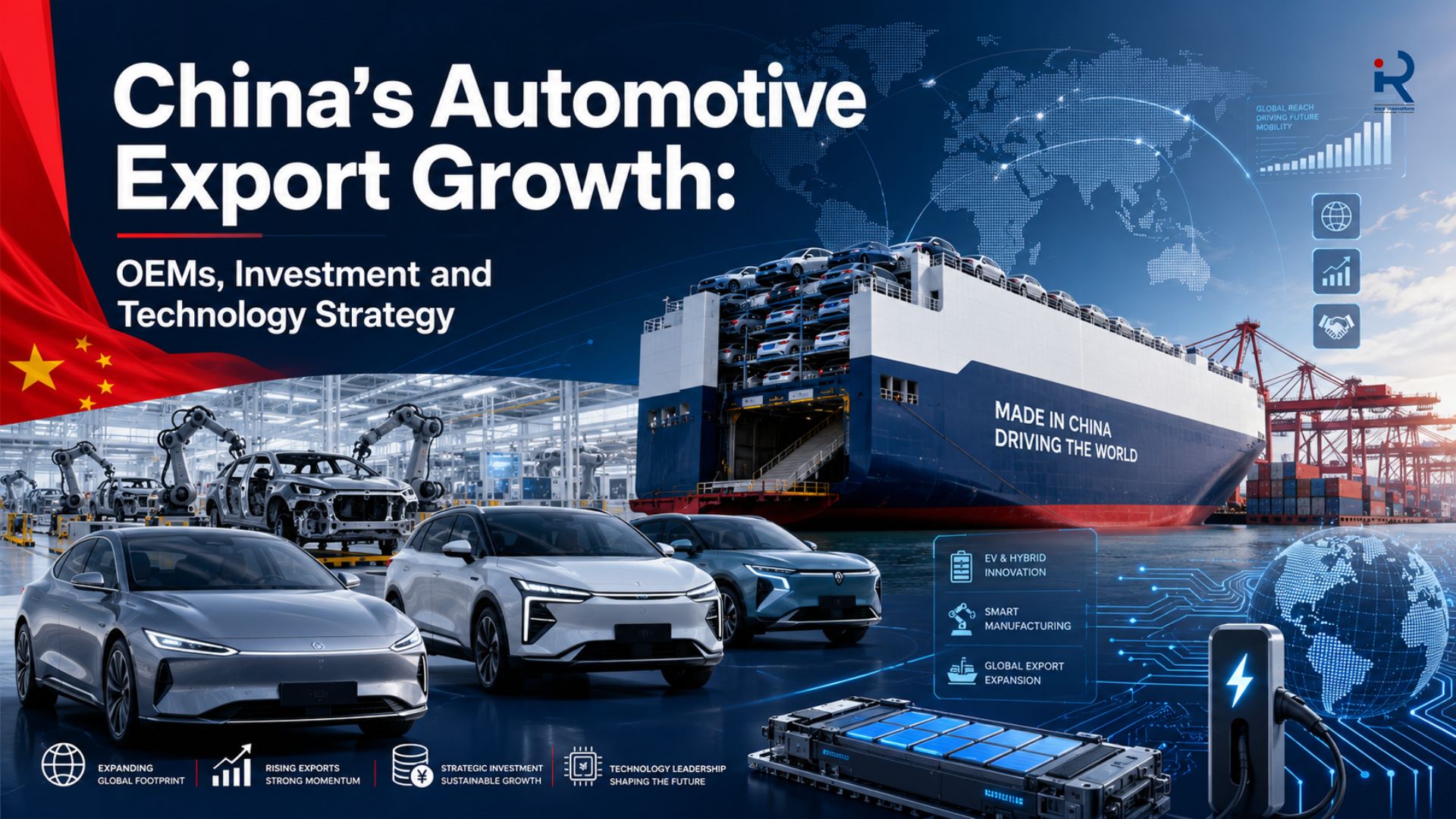
China’s automotive export market is expanding rapidly, supported by rising vehicle shipments, strong new-energy vehicle demand, overseas manufacturing, battery innovation and improved logistics. During the first four months of 2026, China exported around 3.13 million vehicles, up 61.5% year on year, while new-energy vehicle exports reached approximately 1.38 million units, more than double the previous year’s level.
Major Chinese OEMs are contributing to this growth in different ways. Chery exported 943,817 vehicles in the first half of 2026, up 71.5%, supported by the Chery, Exeed, Jetour, Omoda and Jaecoo brands. The company is also strengthening its European operations and R&D presence in Barcelona.
SAIC Motor, led by MG and Maxus, recorded overseas sales of about 735,000 vehicles in the first half of 2026, up 48.7%. SAIC is also investing in logistics through Anji Logistics, which operates vehicle carriers such as the Anji Ansheng, capable of transporting around 9,500 vehicles. This helps the company control freight costs, routes and delivery schedules.
BYD is one of the strongest drivers of China’s NEV export growth. Its overseas sales exceeded 170,000 vehicles in June 2026. The company is expanding local production through a USD 1 billion plant in Türkiye, manufacturing operations in Brazil and European headquarters and R&D activities in Hungary. BYD has also introduced its Super e-Platform, with a 1,000-volt architecture and maximum charging power of 1,000 kW.
Geely is growing internationally through Geely, Lynk & Co and Zeekr. It exported 403,923 vehicles in 2024, up 53%, and has expanded into more than 80 countries. Its strategy includes overseas assembly, electrified powertrains, 900-volt architecture, AI-supported energy management and advanced driver-assistance systems.
Changan sold around 536,000 vehicles overseas in 2024 and is targeting 1.5 million international sales by 2030. Its Rayong plant in Thailand, developed with an investment of around 9 billion Thai baht, produces Deepal and Nevo vehicles for Thailand and other export markets.
Great Wall Motor is expanding mainly through Haval, Tank, Ora, Wey and GWM Pickup. Its overseas sales reached 42,675 units in February 2026, up 37.36%, supported by demand for SUVs, pickups and off-road vehicles across Australia, the Middle East, Africa, Latin America and Central Asia.
Battery investment is another major part of the strategy. In December 2024, CATL and Stellantis announced plans to invest up to EUR 4.1 billion in an LFP battery plant in Spain, with potential capacity of 50 GWh. CATL has also introduced the Naxtra sodium-ion battery, which offers up to 175 Wh/kg of energy density and strong low-temperature performance.
In February 2026, CATL and BMW also began cooperation on battery passports, carbon-footprint calculations, supply-chain traceability and cross-border battery data. These systems will help manufacturers meet stricter overseas regulations on battery materials, emissions and recycling.
China is also expanding transport capacity. SAIC and BYD have developed dedicated vehicle-carrier fleets, while China delivered the Glovis Leader in April 2026, with capacity for around 10,800 vehicles. The vessel includes dual-fuel propulsion, shore-power compatibility and energy-efficiency technologies.
China’s automotive strategy is therefore progressing through four stages:
Vehicle exports → controlled logistics → overseas manufacturing → regional technology ecosystems
This approach helps Chinese manufacturers reduce tariffs, shorten delivery times and improve control over batteries, charging, R&D, logistics and after-sales support.
However, risks remain. The International Energy Agency estimated that China’s reported EV exports exceeded overseas retail sales by more than 25% in 2025, indicating possible inventory accumulation. Future growth will depend on sustainable demand, stronger dealer networks, spare-parts supply, charging infrastructure, resale values and regulatory compliance.
China’s automotive expansion is no longer based only on low-cost exports. It is increasingly driven by OEM investment, advanced batteries, ultra-fast charging, overseas factories, dedicated shipping and localised technology development.
Explore The Featured Report: China Automotive Supply Chain Shift: Risks, Localization & Export Realignment
Report Link: https://raceinnovations.in/reports/china-automotive-supply-chain-shift-risks-localization-and-export-realignment
At Race Innovations, we provide actionable automotive market intelligence to help OEMs, suppliers, fleet operators, consultants, investors and industry leaders make better business decisions.
Our services include:
Automotive Market Research | Vehicle Sales & Production Analysis | Forecast Reports | OEM & Segment Tracking | EV and Alternative Fuel Insights | Competitive Benchmarking | Custom Market Studies | Business Strategy Support
For customized automotive insights, reports or market analysis support, connect with Race Innovations Pvt. Ltd.