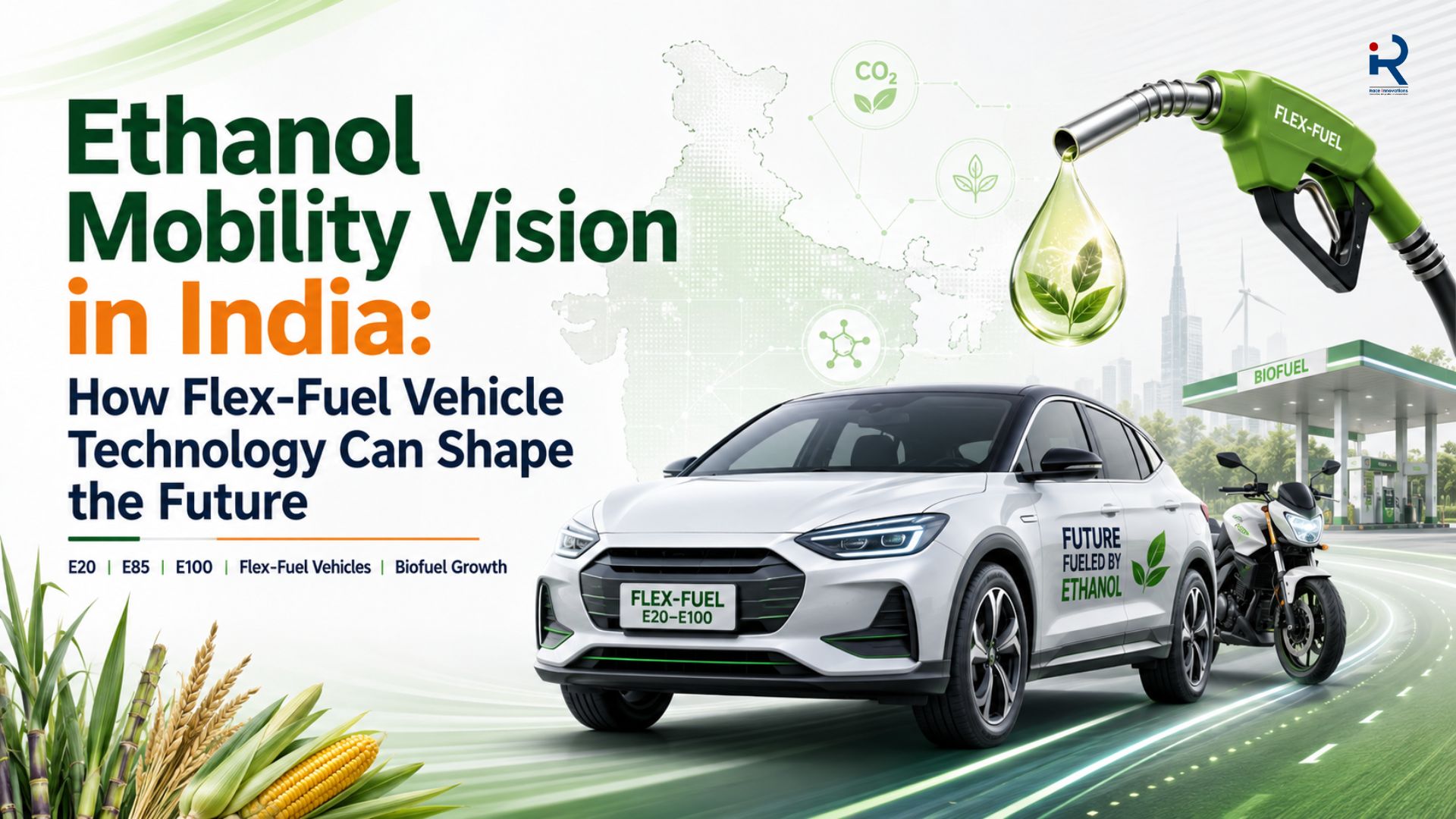
India’s mobility transition is no longer dependent on one technology. Electric vehicles, hybrids, hydrogen, CNG, LNG and biofuels are all becoming part of the cleaner transport roadmap. Among these options, ethanol fuel is gaining strong attention because it can reduce petrol dependence, support farmers, lower emissions and protect the economy from crude oil price volatility.
This has become more important as global crude oil markets continue to face supply risks, geopolitical disruptions and price instability. For India, which imports nearly 88.5% of its crude oil requirement, ethanol-based flex-fuel vehicle technology offers a practical pathway to improve energy security while supporting cleaner mobility.
Ethanol-based flex-fuel vehicle technology is especially important for India because it connects three major national priorities: energy security, rural income and cleaner mobility. Instead of replacing petrol vehicles overnight, ethanol offers a practical transition pathway where petrol can be blended with domestically produced biofuel.
What is Ethanol Fuel?
Ethanol is a renewable alcohol-based fuel produced from plant-based sources such as sugarcane, molasses, maize, damaged grains, surplus rice, crop residues and other biomass. In the automotive fuel industry, ethanol is blended with petrol to create fuels such as E10, E20, E85 and E100.
E10 contains 10% ethanol and 90% petrol.
E20 contains 20% ethanol and 80% petrol.
E85 contains 85% ethanol and 15% petrol.
E100 refers to nearly pure ethanol fuel.
Ethanol has a higher octane value than petrol, which can support better combustion when engines are properly designed and calibrated. However, ethanol has lower energy content per litre, so vehicle performance and mileage depend on engine technology, fuel blend level and calibration.
What are Flex-Fuel Vehicles?
Flex-fuel vehicles are designed to run on petrol, ethanol or different ethanol-petrol blends. Unlike normal petrol vehicles, flex-fuel vehicles use ethanol-compatible fuel-system parts, sensors and engine control software to safely operate with higher ethanol blends such as E20, E85 and E100.
Why India is Pushing Ethanol
India’s ethanol push is mainly driven by three priorities: reducing crude oil imports, supporting domestic agriculture and lowering transport emissions. India imports a large share of its crude oil requirement, which exposes the economy to global oil price shocks, currency pressure and geopolitical supply risks.
Ethanol helps reduce this pressure by replacing part of petrol demand with domestically produced biofuel. When ethanol is produced from sugarcane, grains or agricultural residues, more fuel value remains inside the Indian economy instead of depending fully on imported crude oil.
India’s Ethanol Blending Growth
India’s ethanol blending programme has moved from a fuel policy initiative to a real automotive and biofuel growth story. In October 2024, PIB reported that India had achieved 15% ethanol blending in 2024 and was targeting 20% blending by 2025. This was a major milestone because the E20 target was advanced from 2030 to 2025, showing India’s faster push toward domestic biofuel adoption.
The growth has been strong over the last decade. Ethanol blending increased from 1.53% in ESY 2013-14 to 8.17% in ESY 2020-21, reached 12.06% in ESY 2022-23 and crossed 15% in 2024. Ethanol blending volume also increased from 38 crore litres in ESY 2013-14 to more than 500 crore litres in ESY 2022-23. By September 2024, India’s ethanol production capacity had reached 1,623 crore litres.
The next proof of growth came in June 2026, when ethanol moved from blending targets into vehicle technology. On June 3, 2026, Hero MotoCorp launched India’s first mass-market flex-fuel motorcycles, Splendor+ Flex Fuel and HF Deluxe Flex Fuel. These motorcycles are designed to run on ethanol-petrol blends from E20 to E85. This is important because India has an active two-wheeler fleet of over 300 million vehicles, giving flex-fuel technology a large-scale mass-market opportunity.
On June 4, 2026, Maruti Suzuki launched India’s first flex-fuel passenger vehicle. This marked the entry of ethanol technology into the passenger vehicle segment and showed that flex-fuel mobility is moving beyond two-wheelers. PIB also noted that India’s ethanol blending had increased from around 1.5% in 2014 to 20%, while ethanol procurement had grown from about 38 crore litres in ESY 2013-14 to more than 1,040 crore litres. Ethanol production capacity expanded nearly five times, from 421 crore litres in 2014 to around 2,000 crore litres in 2026.
The government has also outlined a roadmap to build a nationwide flex-fuel ecosystem. Under the proposed roadmap, E85 has been identified as the mono-fuel standard for flex-fuel vehicles under BIS specifications. The plan proposes an initial rollout of 50 to 100 FFV-ready fuel retail outlets in the Delhi-NCR and Mumbai–Pune–Nagpur corridors. This is expected to expand to nearly 500 outlets by December 2026 and around 5,000 outlets across major cities by the end of 2027.
The E85 rollout has already started. On June 5, 2026, E85 fuel was launched across 48 Public Sector OMC retail outlets. E85 contains around 80–85% ethanol and 14–19% petrol and is meant only for specially designed flex-fuel vehicles. The fuel is priced nearly ₹20 per litre lower than conventional petrol, helping pass the benefit of domestic ethanol production to consumers. The rollout is expected to scale to 500 outlets by December 2026 and about 5,000 outlets by December 2027, supporting India’s ethanol blending growth toward nearly 26% by 2030-31.
The latest growth signal is now coming from ethanol source expansion. In June 2026, the Ministry of Petroleum and Natural Gas approved ₹150 crore assistance under PM JI-VAN Yojana for Spray Engineering Devices Limited’s advanced hybrid 2G ethanol project in Uttar Pradesh. The project will set up a 91 KLPD Second Generation Ethanol Biorefinery at Wave Sugar, Dhanaura. It will use agricultural residues and biomass-based technology to produce sustainable ethanol.
This project is important because India’s ethanol growth cannot depend only on sugarcane or grain-based ethanol. 2G ethanol can use agricultural waste such as crop residues and biomass, helping reduce feedstock pressure, support farmers, and build a stronger circular bioeconomy. The project integrates biomass gasification with advanced gas fermentation technology, showing how India’s ethanol ecosystem is moving from conventional feedstocks to advanced biofuel pathways.
Conclusion
Ethanol-based flex-fuel vehicle technology is becoming a practical growth path for India’s clean mobility future. It can reduce crude oil dependence, support farmers, strengthen domestic fuel production and create new opportunities for the automotive industry.
The next phase of growth will depend on wider ecosystem participation. Hero MotoCorp has already contributed with Splendor+ Flex Fuel and HF Deluxe Flex Fuel, compatible with E20 to E85 blends. Maruti Suzuki has entered the passenger vehicle space with India’s first flex-fuel passenger vehicle, capable of operating from E20 to E100.
Other OEMs such as Toyota Kirloskar Motor, TVS Motor, Bajaj Auto, Honda Motorcycle & Scooter India, Tata Motors, Hyundai Motor India and Mahindra & Mahindra can also play an important role in scaling flex-fuel adoption across two-wheelers, passenger vehicles and commercial vehicles.
Along with OEMs, Indian Oil, Bharat Petroleum and Hindustan Petroleum will be important for E85 and E100 fuel retail expansion. Ethanol producers, sugar mills, grain-based distilleries, 2G ethanol developers, component suppliers and farmers will support the supply chain.
In simple terms, India’s ethanol growth will depend on collaboration between government, OEMs, fuel retailers, ethanol producers and consumers. With E20 already mainstream and E85, E100 and 2G ethanol entering the roadmap, ethanol can become a strong bridge fuel for India’s cleaner and more local mobility future.
Explore More Automotive Market Insights
Ethanol-based flex-fuel vehicles are only one part of the broader shift happening in India’s automotive and alternative fuel industry. To understand how cleaner mobility, fuel transition, vehicle demand, production trends, regional opportunities and future market growth are evolving, explore our latest automotive reports and market intelligence insights.
View Report: Flex-Fuel Vehicle Growth Outlook 2026: Ethanol Availability and Market Readiness
Report Link: https://raceinnovations.in/reports/flex-fuel-vehicle-growth-outlook-2026-ethanol-availability-and-market-readiness
At Race Innovations, we provide actionable automotive market intelligence to help OEMs, suppliers, fleet operators, consultants, investors and industry leaders make better business decisions.
Our services include:
Automotive Market Research | Vehicle Sales & Production Analysis | Forecast Reports | OEM & Segment Tracking | EV and Alternative Fuel Insights | Competitive Benchmarking | Custom Market Studies | Business Strategy Support
For customized automotive insights, reports or market analysis support, connect with Race Innovations Pvt. Ltd.