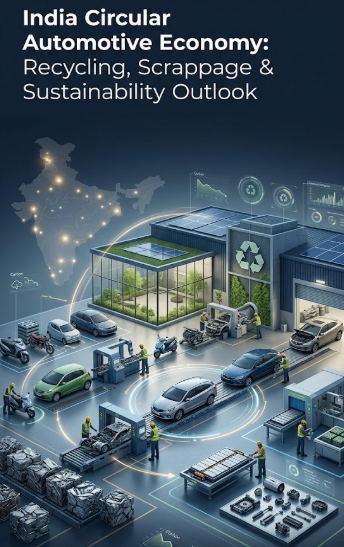
India Circular Automotive Economy: Recycling, Scrappage & Sustainability Outlook
India’s automotive sector is entering a new phase where sustainability is no longer limited to emissions reduction alone. Vehicle scrappage, battery recycling, material recovery, and compliance with circular-economy regulation are becoming increasingly important to long-term industry economics. As India formalizes end-of-life vehicle management, expands EPR-linked waste rules, and builds a stronger recycling ecosystem, circularity is emerging as both a regulatory requirement and a commercial opportunity. This report explores how scrappage systems, battery recovery, ESG pressure, and carbon-footprint compliance are reshaping the Indian automotive industry through 2030.
Key Highlights
Why This Report Matters
This report helps decision-makers understand where the real business case is emerging in India’s circular automotive economy: scrappage networks, recycled-material flows, battery-recovery infrastructure, carbon-compliance costs, and sustainable sourcing opportunities. It is especially relevant because India is now pairing regulatory momentum with broader circular-economy ambition; recent NITI Aayog work highlights both the strategic importance of lithium-ion battery circularity and the wider economic opportunity of circular systems in India.