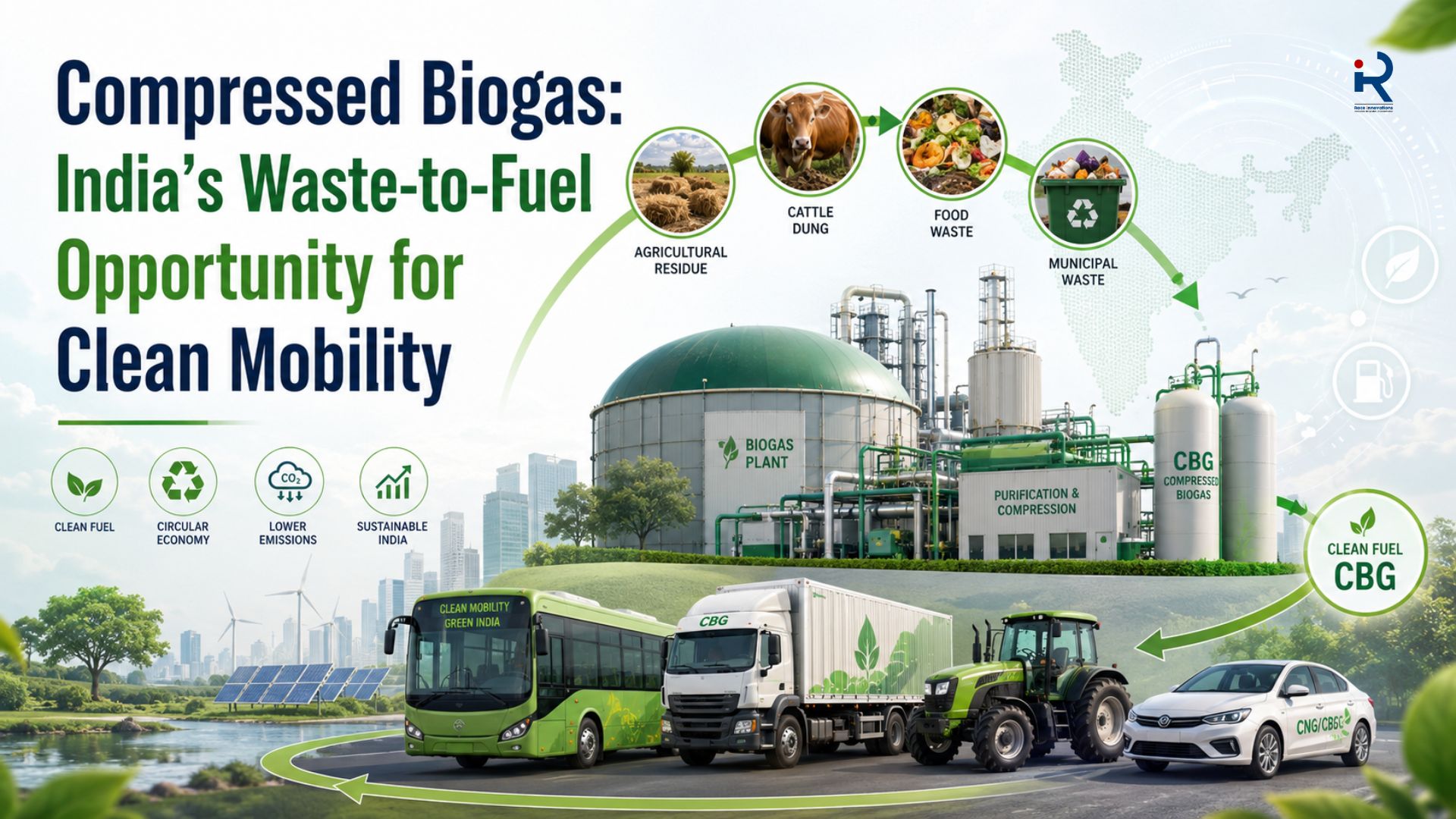
Compressed Biogas, or CBG, is becoming one of India’s most practical clean fuel solutions. Produced from agricultural residue, cattle dung, food waste, municipal solid waste and sewage sludge, CBG converts organic waste into a methane-rich fuel similar to CNG. This makes it suitable for CNG vehicles, buses, trucks, tractors, city gas networks and industrial energy use.
India’s CBG journey gained strong momentum with the SATAT scheme launched in 2018, aimed at promoting CBG production for automotive and commercial use. The government has targeted 5,000 CBG plants, with a potential production capacity of around 15 million metric tonnes per year. This supports India’s broader goal of increasing the share of natural gas in the energy mix to 15% by 2030.
A key growth trigger is the CBG Blending Obligation, which becomes mandatory from FY 2025–26. The blending target starts at 1% in FY 2025–26, increases to 3% in FY 2026–27, 4% in FY 2027–28, and reaches 5% from FY 2028–29 onward. This creates assured demand for CBG across CNG transport and domestic PNG networks.
Government support is also improving project viability. Under the Waste to Energy Programme, CBG projects can receive financial assistance of up to ₹4 crore per 4,800 kg/day for new biogas plants and ₹3 crore per 4,800 kg/day for existing plants, with support capped at ₹10 crore per project.
Private investment is now accelerating the market. Reliance Industries has announced plans for 500+ CBG plants by 2030 and a proposed ₹65,000 crore investment in Andhra Pradesh for integrated CBG hubs. Adani Total Gas is developing the Barsana Biogas Project with planned capacity of 42 tonnes/day of CBG, while BPCL’s Brahmapuram plant is designed to process 150 tonnes/day of municipal waste and produce 5.6 tonnes/day of CBG and 28 tonnes/day of organic manure.
Automotive OEMs are becoming important enablers of Compressed Biogas (CBG) adoption, mainly through CNG-compatible and alternate-fuel vehicle platforms. Since purified CBG has properties similar to CNG, it can be used in existing CNG vehicle technology with limited changes in fuel storage, engine calibration and dispensing infrastructure. This makes OEM participation very important for faster market acceptance.
Tata Motors has already demonstrated bio-methane bus technology, showing how CBG can be used in public transport and commercial mobility. This is highly relevant for city buses, staff transport, municipal fleets and last-mile logistics, where vehicles run fixed routes and can be connected to dedicated refuelling points.
Mahindra has showcased a CBG-powered tractor, highlighting the role of CBG in agriculture. This is a strong use case because farms can generate feedstock such as cattle dung, crop residue and organic waste, which can be converted into fuel and reused in farm operations. This creates a closed-loop rural energy model.
Suzuki is also working on a biogas-to-CBG ecosystem linked to CNG vehicles. This approach connects dairy waste, biogas production and vehicle fuel use, creating a practical model for rural clean mobility. For India, where CNG vehicles are already popular in passenger cars and fleet operations, this can support faster CBG integration.
At the same time, OEMs such as Tata Motors, Ashok Leyland, Eicher, Hyundai and Maruti Suzuki are expanding their CNG-compatible vehicle portfolios. These vehicles can become future-ready for CBG as fuel availability improves through CBG plants, city gas distribution networks and blending obligations. Commercial vehicles, buses, light trucks, three-wheelers, taxis and delivery fleets are expected to be among the early adopters because they have higher fuel consumption and stronger cost-saving potential.
CBG is not just another alternative fuel. It is a circular economy solution that connects multiple sectors. It converts organic waste into clean fuel, reduces landfill pressure, supports cleaner transportation, creates additional income opportunities for farmers and generates organic manure as a useful by-product. This makes CBG valuable for both the energy sector and the agriculture sector.
With government support, mandatory blending targets, private investments and OEM-backed CNG vehicle platforms, CBG has the potential to become one of India’s most practical renewable fuels by 2030. It can reduce diesel and petrol dependence, support cleaner mobility and strengthen India’s long-term energy security.
Conclusion
In the upcoming phase, CBG adoption will be driven by OEMs that already have CNG, Bio-CNG and alternate-fuel vehicle platforms. Tata Motors can support CBG adoption through bio-methane bus and commercial vehicle technology, while Mahindra is expected to strengthen CBG use in agriculture through its CNG/CBG tractor platform. Suzuki/Maruti Suzuki is building one of the strongest CBG-linked ecosystems by converting cow dung into CBG for CNG vehicles, making it important for passenger car and rural mobility adoption. Ashok Leyland and Eicher can support CBG growth through CNG-compatible buses, LCVs and medium-duty trucks, especially for city logistics, public transport and fleet operations.
Overall, the next growth phase for CBG will come from the combination of OEM-backed CNG/CBG vehicle platforms, mandatory blending policy, government subsidies, large private investments and city-level waste-to-fuel projects. By 2030, CBG can become a practical renewable fuel for buses, trucks, tractors, delivery fleets, CNG cars and industrial energy, while also supporting waste management, farmer income and India’s energy security.
Explore More Automotive Market Insights
View Report: Compressed Biogas in India: Strategic Roadmap for Clean Mobility and Energy Security by 2030
At Race Innovations, we provide actionable automotive market intelligence to help OEMs, suppliers, fleet operators, consultants, investors and industry leaders make better business decisions.
Our services include:
Automotive Market Research | Vehicle Sales & Production Analysis | Forecast Reports | OEM & Segment Tracking | EV and Alternative Fuel Insights | Competitive Benchmarking | Custom Market Studies | Business Strategy Support
For customized automotive insights, reports or market analysis support, connect with Race Innovations Pvt. Ltd.